Wasp and Hornet Nest Removal in Kaysville, UT
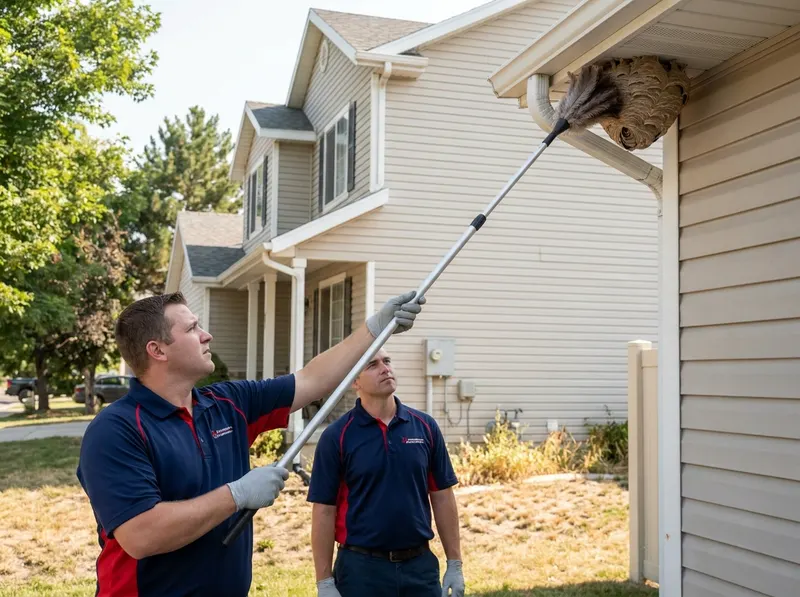
- Included: on-site identification of the species, treatment of the active nest, removal of the nest structure when it can be reached safely, and inspection of nearby eaves, soffit gaps, vents, and ground holes for other colonies.
- Speed: most Kaysville wasp and hornet calls are scheduled within a few days, with a real arrival window rather than an all-day guess — stinging-insect nests over a doorway or on a kids' play area get priority.
- Cost: expect a $500 minimum for wasp and hornet nest work in Kaysville; typical single-nest visits land in the $500–$850 ballpark depending on height and access, with the exact number confirmed before anything is sprayed.
- What we take: the nest itself where reachable — paper wasp combs off eaves and rail undersides, aerial hornet nests out of trees and shrubs, and ground yellowjacket colonies treated at the entry hole. Nests inside wall voids are treated in place because tearing open siding causes more damage than it solves.
- Booking: call or text (385) 206-5679 with your Kaysville street and a photo of the nest if you can take one from a distance. No contract is required for nest removal — this is a one-visit job unless you ask for ongoing exterior service.
The decision most Kaysville homeowners are actually making is one-time nest removal versus a recurring exterior program, and the honest answer depends on where the nest is and what the season is doing. <strong>One-time removal is the right call when you have a specific nest you can point at</strong> — a paper wasp umbrella under the front porch light on a Flint Street bungalow, hornets in the maple out front in the Barnes Park area, yellowjackets going in and out of a hole in the lawn near a Crestwood patio. That nest gets dealt with and the problem is over for that colony. A recurring program makes more sense on homes that re-nest every single year: deep-eave houses along the Kaysville East Bench, properties in Sunset Equestrian Estates with barns, tack sheds, and equipment overhangs, and the older buildings around the Old Downtown Kaysville Main Street district where decades of trim gaps give queens dozens of protected starting points. The trade-off is simple and worth saying plainly: removing today's nest does nothing to stop a new queen from picking the same soffit next April.
Timing matters in Davis County more than most people expect. Queens start small nests in late spring, and a colony that was the size of a golf ball in June is a full working nest by mid-August. <strong>Late August through the first hard freeze is when yellowjackets get genuinely aggressive</strong>, because the colony's food supply shifts and they start hunting sugar — which is why calls spike around backyard barbecues, fruit trees near the Fruit Heights border area, and fallen apples and pears in older Kaysville yards. Ground-nesting yellowjackets are the ones that put people in urgent care, and they are also the ones homeowners most often mistake for honey bees. If your insects are fuzzy, tan-and-brown, and coming out of a wall or a tree cavity in numbers, we identify before we treat — honey bees get referred out, not sprayed.
This is where the diagnosis-first approach earns its keep. A wasp nest under an eave is visible; a yellowjacket colony behind stucco announces itself only as insects trickling out of a weep hole or a gap around a Webb Lane corridor dryer vent. <strong>We look for the entry the colony is actually using</strong> rather than fogging the general area, because treating the wrong side of a wall leaves the colony alive and pushes it deeper — sometimes into the living space. After a wall-void colony is done, sealing that gap is what keeps next year's queen from moving into a pre-made cavity, and we'll show you exactly where it is.
On safety, the two questions we hear most from parents in Deseret Estates and the Snow Horse / Angel Street neighborhood are about kids and pets, and about vegetable beds. Products are applied to the nest and its immediate structure — under eaves, into a ground entry, into a void — not broadcast across lawns or garden rows. <strong>We'll tell you how long to keep children and dogs off the area and what to do with a hive that's directly over a play set or trampoline.</strong> And a straight answer on the DIY question: a $12 aerosol can work on a small, low, exposed paper wasp comb early in the season. It works poorly on an established ground nest or a bald-faced hornet nest at ladder height, and those are the two situations where people get stung repeatedly on their own property.
Call (385) 206-5679Wasp and Hornet Nest Removal pricing in Kaysville
| Single accessible nest — porch eave, deck rail, shed overhang (Kaysville) | $500–$650 |
| Multiple nests treated on the same visit, same property | $500–$800 |
| Bald-faced hornet aerial nest in a tree or shrub (ladder access) | $550–$850 |
| Ground-nesting yellowjacket colony in lawn or landscape bed | $500–$750 |
| Hard-access nest — second-story soffit, gable vent, high eave | $650–$1,100 |
| Wall or soffit void colony: treatment plus entry-point sealing | from $750, quoted on-site |
Exact price confirmed free on-site before any work.
Wasp and Hornet Nest Removal — questions, answered
How much does wasp and hornet nest removal cost in Kaysville?
Wasp and hornet nest removal in Kaysville starts at a $500 minimum, and most single-nest visits fall in the $500–$850 range. Height, access, and whether the colony is exposed or inside a wall void are what move the number. These are ballparks — the exact price is confirmed on-site during a free look before any treatment happens, and there's no contract attached to a nest removal visit.
Do you remove the nest or just spray it in Kaysville homes?
Both, when the nest can be reached safely. On Kaysville homes we treat the active colony and then physically take the nest structure down — paper wasp combs off eaves and rail undersides, and aerial hornet nests out of trees. Nests inside a wall or soffit void are treated in place and left there, because opening up siding or drywall to pull out a dead nest causes more damage than it prevents.
Is wasp treatment safe around kids, pets, and vegetable gardens in Kaysville?
Application is targeted at the nest and the structure it's attached to, not broadcast across Kaysville lawns or garden beds. That keeps product away from vegetable rows, sandboxes, and dog runs. We'll give you a specific re-entry window for the treated area before we leave, and if a nest sits directly above a play set or trampoline we'll tell you plainly how long to keep that spot clear.
When is wasp and hornet season worst in Kaysville and Davis County?
Late August through the first hard freeze is the peak for aggressive wasp activity in Kaysville and across Davis County. Colonies are at maximum size by then and yellowjackets shift to hunting sugar, which is why they show up around fruit trees, garbage cans, and backyard food. Nests started in late spring are small and easier to handle, so an early-summer call is usually the cheaper and calmer one.
Will removing one nest stop wasps from coming back to my Kaysville house?
Removing a nest ends that colony, but it does not stop a new queen from choosing the same spot next spring — especially on Kaysville homes with deep eaves, open soffit gaps, or unsealed vents. That's why we point out the specific gaps and cavities on your house during the visit. Sealing those entry points is what actually changes the pattern, and homes that re-nest every year are the ones where ongoing exterior service is worth considering.